

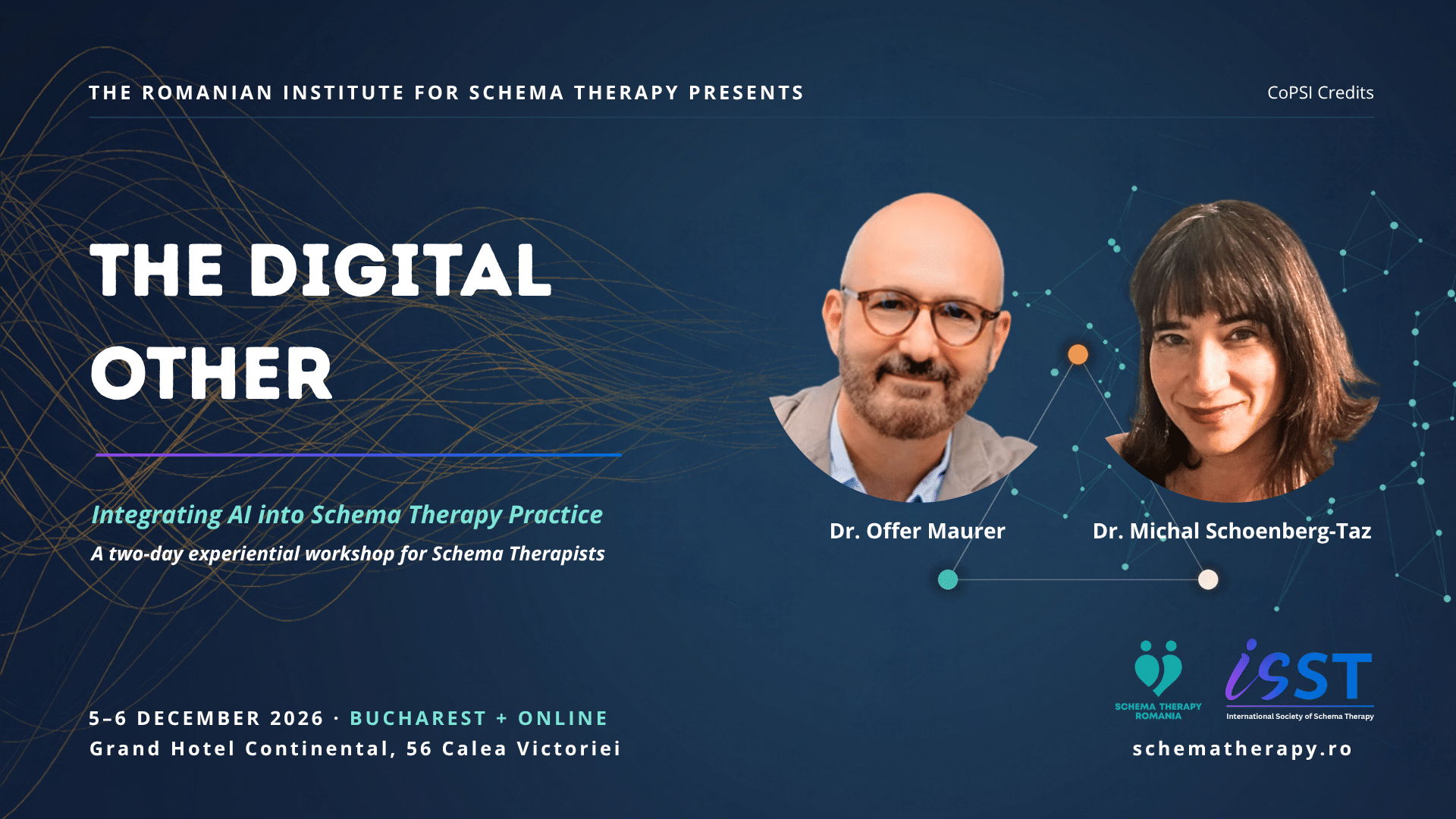
Integrating AI into Schema Therapy Practice
A two-day experiential workshop for Schema Therapists
| KEY FACTS | |
| Date | Saturday, 5th of december 2026, 09:00–17:30 · Sunday, 6th of december 2026, 09:00–14:00 |
| Venue | Grand Hotel Continental, 56 Calea Victoriei, Bucharest — and online |
| FORMAT | Hybrid · up to 40 places in the room · online places available |
| PRESENTERS | Dr. Offer Maurer and Dr. Michal Schoenberg-Taz |
| FOR | Psychologists, psychotherapists, psychiatrists and mental-health professionals trained or training in Schema Therapy |
| Language | English |
| FOLLOW-UP | Free 90-minute online group supervision, Friday 18 December 2026 |
| Bring | A laptop or tablet and a free account on ChatGPT, Claude or Gemini — no technical knowledge needed |
| CPE CREDITS | Accreditation in progress |
| FEE | 1200 RON Early Bird (get before 31.10.2026)
1500 RON (after 1.11.2026) |
Artificial intelligence has entered the consulting room, whether or not we invited it. Clients now turn to chatbots and mental-health apps between sessions — precisely in the hours when schema modes are most active and the therapist’s reparenting voice is least available. The research tells a double story. Randomised trials show real reductions in depression and anxiety, greater self-disclosure and short-term relief from loneliness. Equally real are the documented harms: emotional dependency, hollow or engineered empathy, safety failures with high-risk users, embedded bias and a regulatory vacuum.
Acest workshop îi invită pe schema terapeuți să țină în minte ambele adevăruri în același timp — să fie fascinați și neliniștiți This workshop invites Schema Therapists to hold both truths at once — to be fascinated and troubled — and to turn that tension into clear clinical thinking. Developed from the presenters’ two-day programme at McGill University’s Student Wellness Hub in Montreal and their ISST INSPIRE 2026 workshop in Thessaloniki, it offers a concrete, transferable method: using the Schema Therapy map of modes and needs to understand, instruct and bound the AI our clients already use.
Day 1 - Saturday
The Human–AI Dyad
How AI works, told in clinicians’ language — from ELIZA to today’s large language models.
What the evidence says: benefits, harms, and seven principles for evidence-informed practice.
Live demonstration: a generic chatbot and a Schema-Therapy-informed assistant answer the same client, side by side.
The anatomy of a clinical prompt — then build and test your own, mode by mode.
Day 2 - Sunday
The Emerging Triad
From dyad to triad: therapist, client and AI — and the “AI Third” as the therapy’s voice extended into the week.
Prompt co-creation as therapy: building the tool together as Healthy Adult work.
Live supervision on stage with an AI-simulated client — then deliberate practice in small groups.
Ethics and guardrails: consent, confidentiality, GDPR, the EU AI Act, risk and contraindications.
What makes this workshop different
- ● It is clinical, not technical. No prior knowledge of AI is needed. Every concept is translated into the language of modes, needs and reparenting.
- ● You see it happen live. Prompts are written, tested and edited on screen; a volunteer is supervised on stage while working with an AI-simulated client, which then steps out of role to give feedback.
- Plecați cu ceva construit de voi. ● Each participant drafts and tests a mode-specific prompt for the between-session interval, intended for one of their own clients (anonymized), along with a plan for its safe implementation
- Terapeutul rămâne la conducere. ● AI is taught as an adjuvant tool, under the therapist's clinical responsibility — never as a therapist, never as a companion, never as a crisis service.
- ● Learning continues after the weekend. A free 90-minute online group supervision session two weeks later helps participants bring real cases, prompts and dilemmas.
Who should attend
Psychologists, psychotherapists, psychiatrists, counsellors and other licensed mental-health professionals trained in Schema Therapy at any level, including trainees in Schema Therapy programmes. Familiarity with the schema mode model and limited reparenting is assumed.
 English
  Romanian